Decoupled cryogenic cooling: How circulators with gas-bearings reduce downtime and vibration
Celeroton’s oil-free cryogenic gas circulator separates cooling generation from the customer system, enabling independent serviceability, contamination-free operation, and intrinsically low mechanical vibration levels.
A new approach to cryogenic cooling
Celeroton introduces an actively driven cryogenic gas circulation concept that transfers cooling from a mechanically isolated cold source – such as Pulse Tube, Stirling, Gifford-McMahon (GM) Reverse Turbo-Brayton cryocooler – to the customer system. As an innovative gas circulator for cooling systems, it enables fully decoupled cryogenic architecture.
Rather than relying on direct cold-head attachment, cooling is transported via a closed-loop, allowing for spatial separation between cooling generation and cooling demand. This circulation is provided by a high-speed, oil-free cryogenic gas circulator based on dynamic gas bearing technology.
The absence of lubricants and mechanical contact eliminates wear and contamination risks, resulting in a long operational lifetime. The gas bearing principle enables inherent vibration-free operation, which is essential for preserving the electromagnetic and mechanical integrity of customer systems and surrounding structures. This makes the circulator well suited for a wide range of applications, including the cryogenic cooling of optical instruments, high-temperature superconducting coils, and busbars.
Design and operating principle
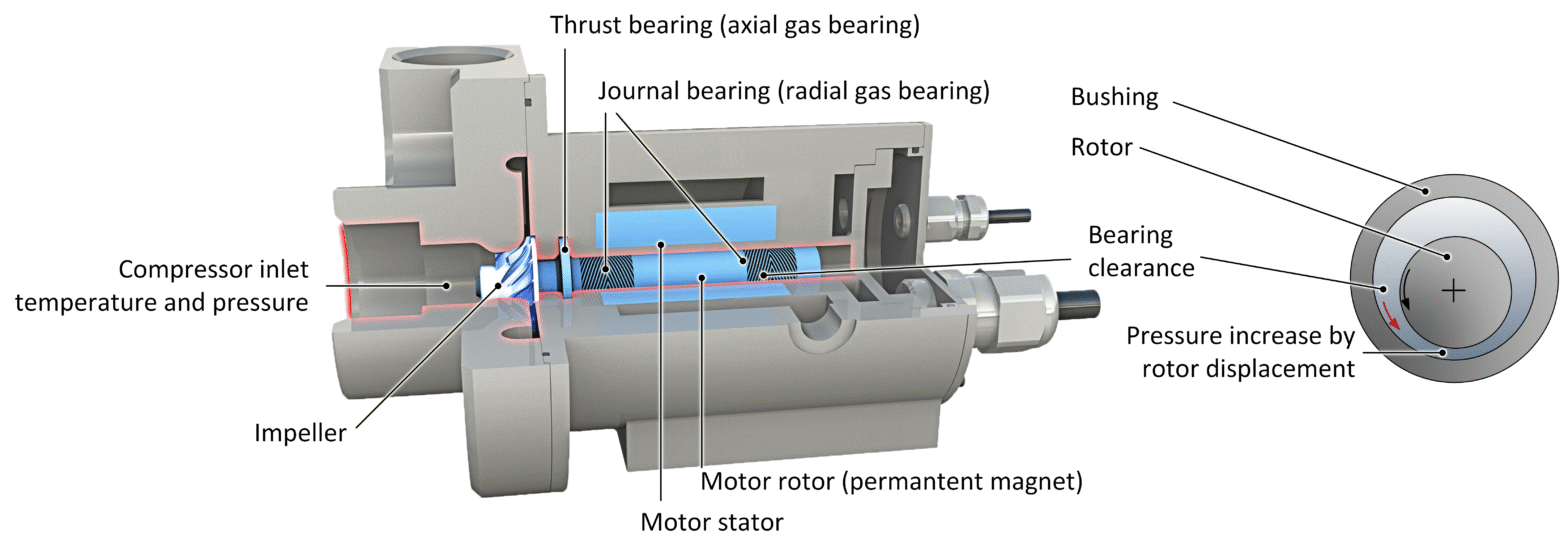
The cryogenic gas circulator consists of an impeller mounted on a shaft with radial and axial bearings. The impeller increases pressure through dynamic principles, thereby driving the cryogenic loop. During operation, the rotor floats on a gas cushion generated by its rotation and surface structure. Surrounded by cryogenic gas, which acts as bearing lubricant, the design is inherently oil- and contamination-free. Static seals isolate the gas section of the circulator, ensuring wear- and maintenance-free operation. A permanent magnet embedded in the rotor forms the motor together with the external motor stator. The combination of continuous gas flow driven by the impeller and contact-free gas bearings enables vibration-free operation.
Cryogenic gas bearing and sealing concept
Serviceability and independent access
From an operational and maintenance perspective, circulator-based cooling architecture represents a significant step forward in system serviceability. Both the circulator and the primary cooling unit can be accessed, and replaced independently of the customer system, enabling predictive and condition-based maintenance strategies.
System health monitoring
Key operational parameters – including pressure ratio, mass flow, rotational speed, efficiency, and vibration signatures – can be continuously monitored, providing direct indicators of system health.
Reliability and operating cost
By decoupling cooling delivery from cooling generation, Celeroton’s circulator reduces downtime, limits intervention frequency, and increases overall system availability – all key drivers for lowering operational expenditure. In addition, the cryogenic circulation approach enables micro-vibration-free delivery of cryogenic cooling to the customer system, further reducing wear and enhancing long-term reliability.