Oil-free helium recirculation as the key to precise isotope enrichment

Isotopes play a central role in the semiconductor industry, in renewable energies, medical diagnostics and research, and other markets. The enrichment of these isotopes is based on the circulation of high-purity carrier gases such as helium. Stable process conditions, maximum purity, and maximum availability of the systems used are essential. To make helium recirculation more efficient, low-maintenance, and more reliable, an internationally active isotope manufacturer based in the USA uses modern, oil-free turbo compressor technology – setting new standards in the process.

ASP Isotopes, a company active in the field of isotope production, develops and operates facilities for the enrichment of isotopes. These isotopes are used in the semiconductor industry, in medical technology for imaging procedures, and in diagnostics and therapy, among other areas. The underlying processes are highly sensitive: even the slightest contamination or unstable operating conditions can impair product quality or jeopardize the entire process.

“Our processes require extremely high gas purity and stable process control at all times. Helium plays a central role as a carrier and process gas,” explains Heino van Wyk, Head of Engineering at ASP Isotopes. “At the same time, we face the challenge of using resources efficiently and consistently avoiding downtime.”

Challenge: Circulating helium efficiently, cleanly, and reliably

Helium is a valuable and limited noble gas. In isotope enrichment, it is often used as a carrier gas for various isotopes in the cycle. The compressors provide the required pressure ratio to overcome pressure losses in this cycle, with minimal losses and no contamination. Conventional compressor solutions quickly reach their limits here: oil-lubricated systems require complex separation and filtration processes, increase maintenance costs, and always carry the risk of contamination. “In our processes, any form of contamination is critical,” emphasizes Heino van Wyk. “In addition, we wanted to reduce energy consumption and significantly reduce the maintenance requirements of our systems.”

Celeroton Turbo Compressor CT-1050 for helium.

Technological approach: Oil-free turbo compressors with gas bearings

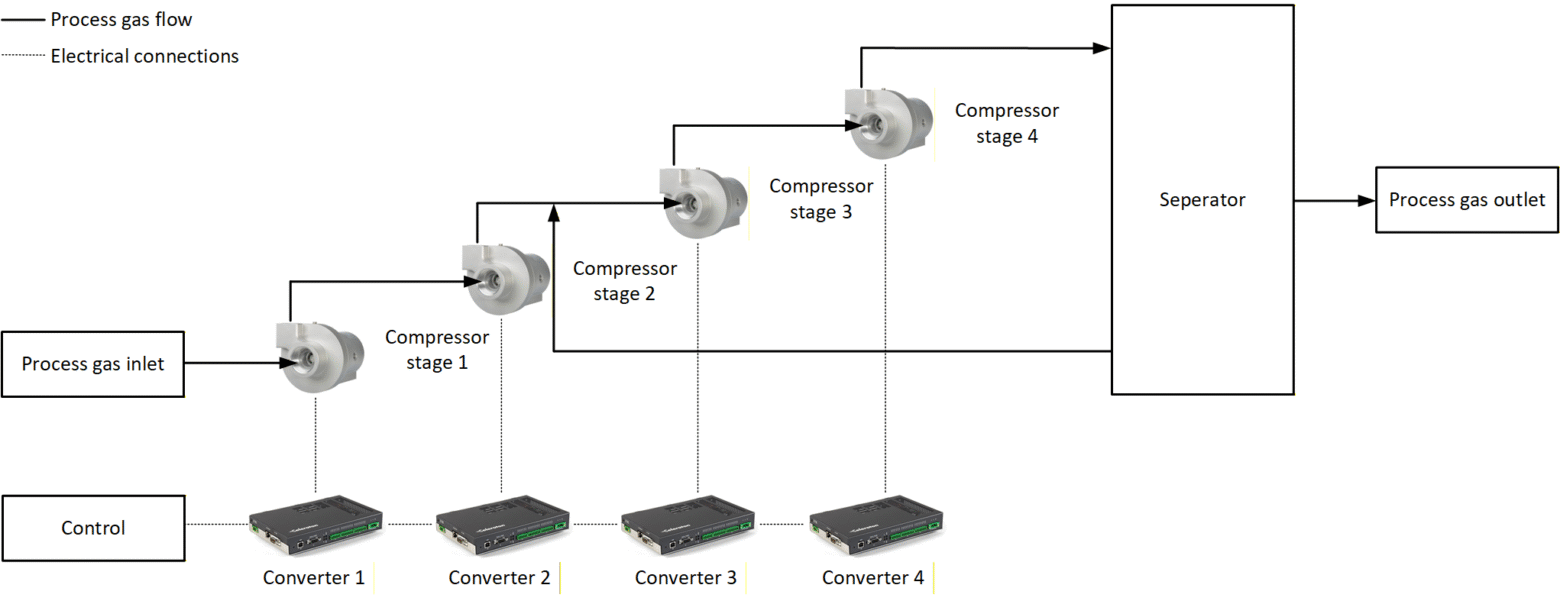
To meet these requirements, ASP Isotopes relies on a solution from Celeroton that is completely oil-free and specially designed for the recirculation of noble and inert gases. Our high-speed, gas-bearing turbo compressors are used for this purpose. We supplied ASP Isotopes with turbo compressors and the associated control electronics. In total, the production plant at ASP Isotopes comprises ten units, each with 48 turbo compressors, with four turbo compressors arranged in series to deliver the required mass flow and pressure ratio for an isotope separator.

Four-stage interconnection of the gas-bearing turbo compressors with the isotope separator.

At the heart of these turbo compressors are rotors that float on a self-supporting gas film via herringbone gas bearings. Contactless operation prevents mechanical wear, eliminates potential sources of contamination, and enables a permanently stable, high-purity helium cycle. “The absence of oil proves to be a decisive advantage,” explains our colleague Raphael Moser, Sales Manager at Celeroton AG. “This not only eliminates oil separators and additional filter stages, but also potential sources of error. At the same time, the purity of the process gas is permanently ensured.”

Efficient processes even with high requirements

The turbo compressors developed by Celeroton are characterized by extremely high speeds of over 100,000 revolutions per minute, a very compact design, and a continuous, pulsation-free gas flow. The gas-bearing design also eliminates mechanical micro-vibrations that can occur in oil-lubricated or mechanically mounted compressors.

“For us, it was crucial that the system not only works efficiently, but also remains reliable over a long period of continuous operation,” says Moser. “In particular, the low maintenance requirements and the oil-free nature of the turbo compressors used have a positive impact on the customer’s success.” From the technology provider’s point of view, this application is also a typical example of the strengths of gas-bearing turbo compressor technology. “Our systems are designed for applications where purity, efficiency, and availability are top priorities,” explains Moser. “Helium recirculation in isotope enrichment combines all these requirements to a particular degree.”

Segment with 48 turbo compressors connected in series for isotope enrichment.

Maintenance-free operation and efficiency as an economic advantage

Another key aspect of the solution used is that our turbo compressors are virtually maintenance-free. Thanks to contactless bearings, there is no mechanical wear or classic friction losses. Oil changes, seal replacements, and the operation of complex oil management systems are completely eliminated. The systems are designed for very long operating times of up to several tens of thousands of operating hours and for a high number of start-stop cycles. This is a considerable advantage, especially in industrial plants with continuous operation.

“In many applications, our turbo compressors run for years without unplanned downtime,” explains Moser. “For operators, this not only means higher plant availability, but also significantly better predictability of service and maintenance windows.” At ASP Isotopes, this aspect, together with efficiency, has a direct impact on the economic performance of the plants. “Maintenance-related downtime is particularly critical for us,” says van Wyk. “The high reliability of the technology used significantly reduces this risk and, together with its high efficiency, lowers operating costs over the entire life cycle.”

Tightness as a contribution to sustainability

In addition to the process-related and economic advantages, the sustainable use of resources is also playing an increasingly important role. Helium is a finite raw material that is costly to extract and is required in many high-tech industries. Efficient recirculation therefore makes an important contribution to conserving resources.

The closed cycle and high tightness of the Celeroton turbo compressors used reduce helium losses to a minimum. In addition, the isotopes are often dissolved in the carrier gas and form toxic or explosive compounds that must not be released into the environment.

“The combination of oil-free operation and high tightness is a decisive factor for us,” says Heino van Wyk. “It enables us to efficiently circulate helium and isotopes while complying with the highest safety and quality requirements.”

From Celeroton’s perspective, this application addresses a key trend in the industry: “Efficiency and technology can be combined very well here,” summarizes Moser. “Our technology helps to keep critical gases in a well-sealed cycle while optimizing energy use.”

Conclusion

Our gas-bearing, oil-free turbo compressor technology takes helium recirculation in isotope enrichment at ASP Isotopes to a whole new level. This clearly demonstrates that the highest requirements for gas purity, process stability, and plant availability can be reliably met.

The combination of maintenance-free operation, high energy efficiency, compact design, and precise controllability has a positive impact both technically and economically. At the same time, the efficient recirculation of helium supports a more sustainable use of a scarce raw material.

For operators of sensitive processes in medical technology, research, and the process industry, this approach offers a future-proof solution for implementing complex applications in a stable, efficient, and resource-saving manner.

Cookies
Celeroton

We use cookies to improve your online experience.

Essential cookies

Essential cookies should be enabled at all times so that we can remember your cookie settings.

Third party cookies

This website uses Google Analytics to collect anonymous information such as the number of visitors to the website and the most popular pages. Keeping this cookie enabled helps us to improve our website.