Small-scale hydrogen liquefaction enabled by Celeroton turbomachinery
Liquid hydrogen (LH₂) is gaining importance as an energy carrier for applications that require high energy density, seasonal energy storage or the transport of large amounts of energy. Potential fields of use include mobility, aviation and energy storage. At the same time, increasingly decentralised hydrogen production is creating demand for compact, efficient and oil-free refrigeration technologies for small-scale liquefaction, re-liquefaction and Zero Boil-Off applications.
The CryoLH2 project, which Celeroton carried out with support from shirokuma and the Swiss Federal Office of Energy, investigated the technological foundations of modular Reverse Turbo-Brayton cryocoolers for future hydrogen liquefiers and other cryogenic applications. The work focused on cooling capacities from 100 W to 1 kW at a temperature of 20 K. The project defined a representative reference system, designed and evaluated the thermodynamic process and specified the key components required for future development.
Closing the gap in small-scale cryogenic cooling
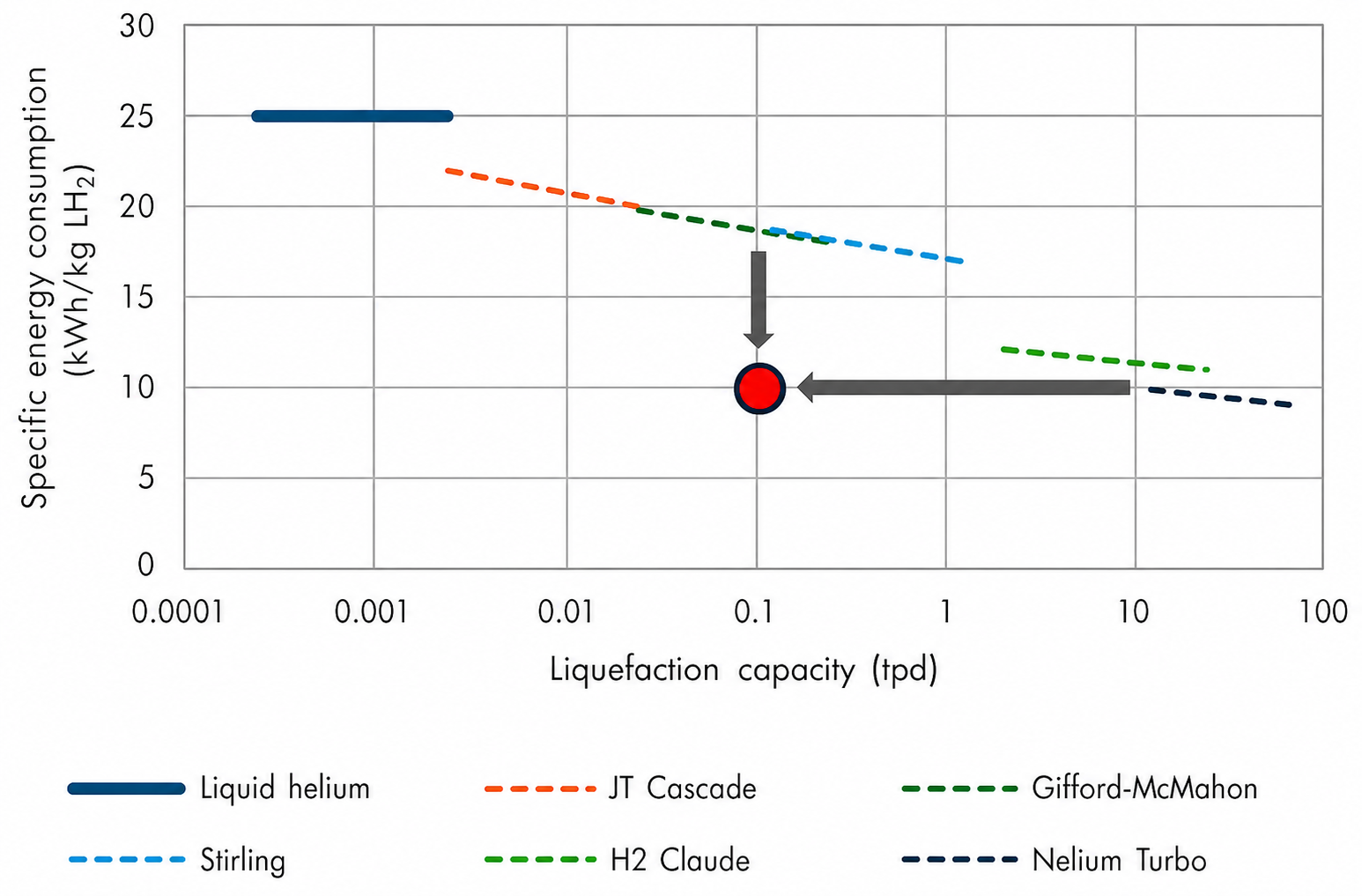
Hydrogen is currently liquefied primarily in large plants with typical capacities of 1 to 30 tonnes per day. These plants generally use multistage cryogenic refrigeration processes followed by Joule-Thomson expansion.
As hydrogen production and use become more decentralised, smaller liquefaction systems with capacities of approximately 0.01 to 1 tonne per day are required. There is currently a technological gap between the cryocoolers used in large hydrogen liquefaction plants and smaller Gifford-McMahon or Stirling cryocoolers. Compact Reverse Turbo-Brayton cryocoolers can address this gap and provide cooling at around 20 K for small-scale liquefiers as well as other industrial applications.
Relevant applications include small-scale hydrogen liquefaction for long-range drones, decentralised energy storage, research and development, smaller vehicle fleets and local refuelling infrastructure. The same technology can support the re-liquefaction of boil-off gas and Zero Boil-Off operation in maritime LH₂ tanks, airport and aviation ground infrastructure, aerospace systems, tank farms, logistics facilities and transfer terminals. Further cryogenic applications include superconducting magnets, cables, motors and generators, quantum computing, instrument optics and detectors.
Gas-bearing compressors and expanders as key enablers
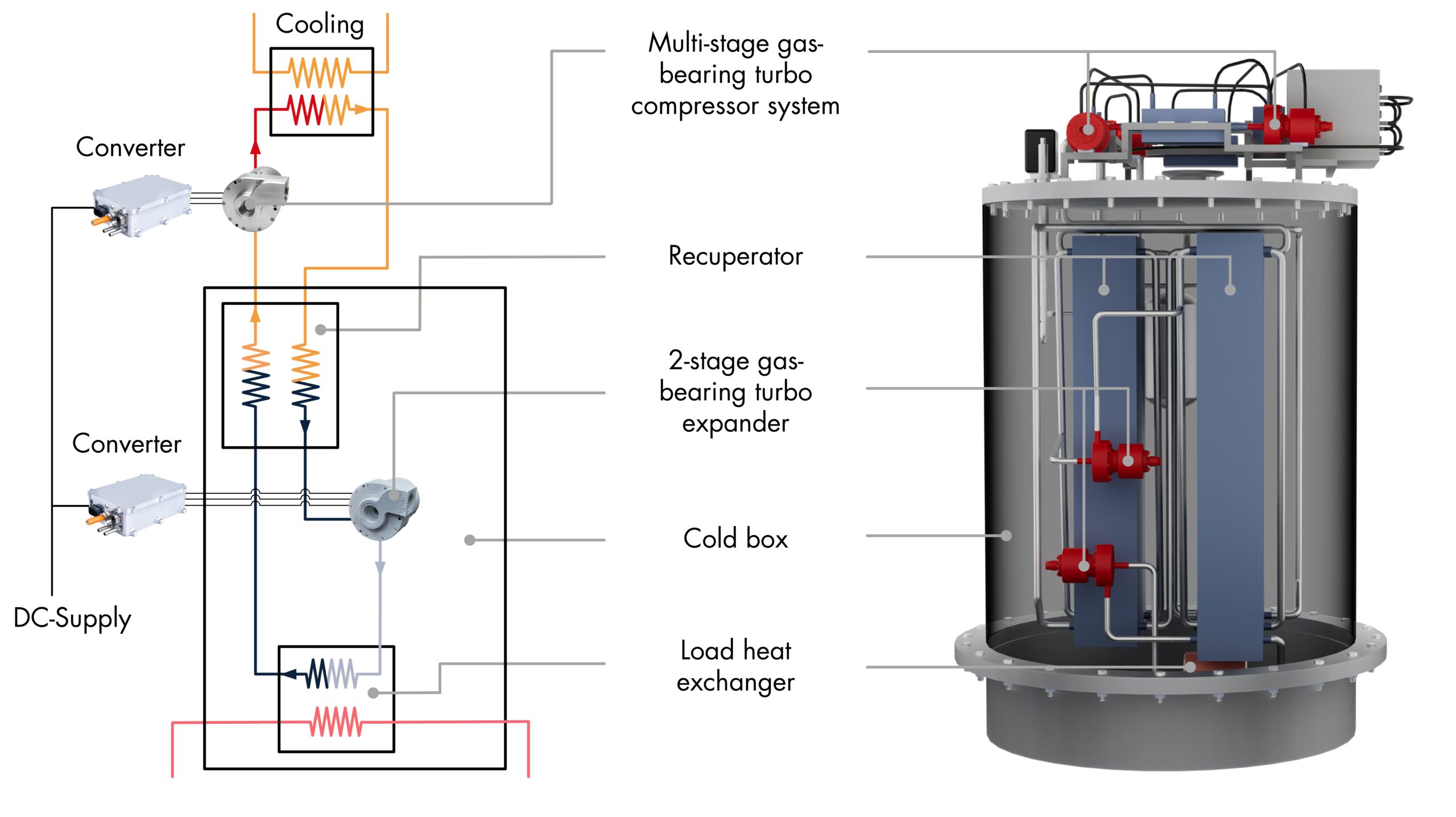
A Turbo-Brayton cryocooler is based on the core components compressor, expander and heat exchanger. Celeroton’s technology is used for both the compressor and the expander. The compressor increases the pressure of the process gas, such as helium. The recuperator cools the high-pressure flow, while the expander reduces the pressure and temperature of the gas, thereby generating the required refrigeration.